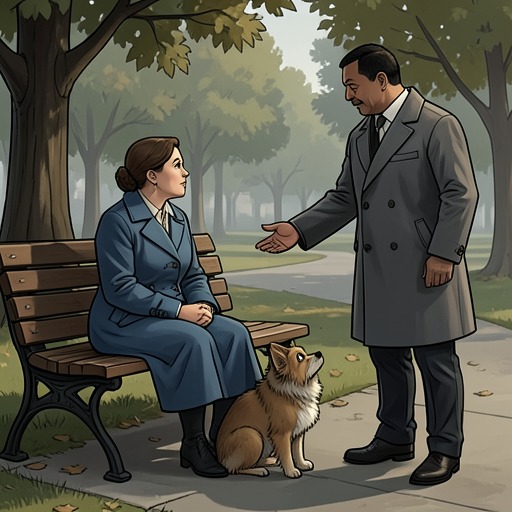
What are we, Apollo and I, if not two solitudes that protect and border and greet each other
The Friend“What are we, Apollo and I, if not two solitudes that protect and border and greet each other?” gives the narrator’s bond with Apollo its defining image: two distinct lives made close through attention, protection, and repeated acts of care. The phrase emerges while Apollo sleeps after a day of walking, play, grooming, conversation, and poetry. Its image of solitude does not describe indifference; it makes room for closeness without pretending that one being can wholly know or become another.
The phrase in its scene
The narrator watches the peaceful rise and fall of Apollo’s flank. He is full, warm, and dry after a four-mile walk. That ordinary inventory of his comfort gives the expression its grounding: the relationship is felt through a body that has been fed, exercised, and cared for, not through an abstract claim about devotion. The narrator has guarded him from passing cars when he stopped in the street, and Apollo has barked and blocked a texting jogger who was running toward the narrator in the park. Protection passes between them, though not in identical forms.
After several rounds of tug-of-war, talking, singing, and reading poetry aloud, the narrator trims Apollo’s nails and brushes his coat. Watching him sleep brings a surge of contentment, followed by a deeper feeling that takes a full minute to name. The question names that recognition without dissolving their difference: each remains a solitude, yet each protects and acknowledges the other.
Care, boundaries, and attachment
The phrase’s verbs make the bond reciprocal and measured. To protect is to act for the other’s safety; to border is to recognize a boundary rather than erase it; to greet is to keep meeting across that boundary. The day’s details give each verb a concrete counterpart, from guarding Apollo beside traffic to his intervention between the narrator and the jogger. Their closeness is sustained through repeated attention, not presented as proof that Apollo’s inner life is fully knowable.
The narrator’s certainty that nothing will separate them follows the scene’s settled feeling. The narrator allows for a miracle or its absence, but insists on the bond’s continuity. In this context, the expression is neither a declaration of sameness nor a promise that nothing can change; it is a description of companionship as mutual presence, care, and regard for separateness.
The phrase beside bereavement
Elsewhere, the narrator addresses a dead friend in the second person and describes the dead as dwelling in the conditional, the tense of the unreal. That address carries an extraordinary sense that the friend can read words before they are written, even as the narration marks the friend’s absence. The phrase about Apollo belongs to a different relation, but its emphasis on two solitudes clarifies how intimacy can coexist with what remains unknowable or unreachable.
The narrator states the loss plainly: “I miss you. I miss you every day. I miss you very much.” Later, the wording shifts from addressing “you” to remembering “him”: “I miss him. I miss him every day. I miss him very much.” The repeated cadence keeps the feeling present while the changed pronoun registers the distance between speaking to the dead and speaking about him. The book does not present this repetition as a resolution of grief.
Naming and the limits of consolation
Near the close, the narrator wants to call the friend’s name, but the word dies in the narrator’s throat. The blocked utterance is followed by the cry, “Oh, my friend, my friend!” Where the phrase about Apollo names a feeling discovered in the quiet of shared care, the final address to the friend exposes the limit of naming: the bond can still be spoken, but the name itself cannot be voiced. Together, these moments make the expression a measure of living companionship and a contrast to the unfinished address through which the narrator continues to mourn.